Page Content
Shelley Svidal, ATA News
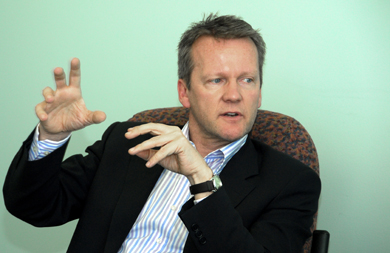
Picking up where David Berliner left off, Pasi Sahlberg urged participants to reframe accountability for a knowledge society.
Picking up where David Berliner left off, Pasi Sahlberg urged participants to reframe accountability for a knowledge society.
The senior education policy expert at the European Training Foundation in Turin, Italy, pointed out that, by 2030, there will be so many degree and qualifications on the planet that they will be valueless. According to the International Labour Organization, 50 million jobs will disappear in 2009 alone, never to return.
Building a knowledge society is based on relationships of trust, the foundation of all innovation, he said. Rather than grounding their education policies on that culture of collaboration, however, most countries ground their policies on a culture of competition. To succeed in a knowledge society, countries must shift their mindset from raising standards to finding one’s talent, from the achievement gap to equal educational opportunity and from high-stakes accountability to shared responsibility.
"There is another way," Sahlberg suggested, pointing to his native Finland. The country has a competitive economy, is technologically advanced and boasts a great public education system. Indeed, some international rankings have found the Finnish people are the happiest in the world. Finns are also very good risk-takers, a condition of innovation.
Finland’s education system is financed entirely from the public purse. There are no private schools, and Finns receive their K–12 and postsecondary education free of charge. In addition, students do not start school until they are seven years of age although they have the option of attending preschool before then.
This has all come about because, in the 1990s, the Finnish government decided to raise the educational level of all so that Finland could become a nation among nations. Equal educational opportunity became paramount, and that mindset helped pull Finland out of a recession.
At the same time, Finland’s education system is full of what North Americans would describe as paradoxes. One of those paradoxes is "less is more." By international standards, Finland has a relatively small number of school days, and Finnish teachers teach less than 600 hours a year in the classroom. Teachers spend their remaining time developing curriculum and assessing and reporting student progress, for which they are solely responsible. As well, Finnish students do little homework.
Another paradox is "more learning is less testing." Sahlberg pointed out that, while the results of Finland and Poland are improving on the Programme for International Student Assessment, other countries’ results are declining. In fact, Finns do not even have a word for accountability. There is no external, high-stakes testing, with the exception of the Grade 12 matriculation examination, which is separate from school and consists entirely of open-ended, essay questions.
The third paradox is "diversity brings equity." Authority over curriculum and student assessment lies with the school, so while Finnish schools are different, they have similar values and principles. Most students are high performing, and high school dropout rate hovers around three per cent.
The fourth paradox is "the better a high school graduate is, the more likely he or she wants to be a teacher." Finland’s education system has made teaching an attractive profession. Twenty-two per cent of high school graduates in Finland see teaching as their dream profession. In fact, the faculty of education has the highest admission standards. Eighty per cent of the teaching profession is female, and very few teachers leave the profession within the first five years. At one time, Nokia, one of Finland’s flagship corporations, focused its headhunting efforts on primary school teachers.
In short, Finland has shunned a focus on core programs; the curriculum is broad and creative. It has shunned prescribed standards, allowing schools to develop their own curriculum. It has shunned the cry for more reform, focusing instead on learning from others. It has shunned increased accountability, adopting the mantra of shared responsibility. And it has shunned more control over schools and teachers in favour of building trust between educators and the community. Finnish schools "are accountable for maintaining the school as a place for learning and individual growth," Sahlberg concluded.
—Photo by Koni Macdonald
In the News