Page Content
Shelley Svidal, ATA News
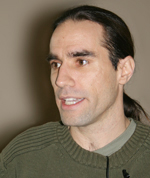
Joe Brewer, a fellow of the Rockridge Institute, integrated the keynote addresses of David Berliner and Pasi Sahlberg, by providing participants with practical strategies for reframing the accountability debate to guide Alberta’s education system away from the American model and toward the Finnish one.
Joe Brewer, a fellow of the Rockridge Institute, integrated the keynote addresses of David Berliner and Pasi Sahlberg, by providing participants with practical strategies for reframing the accountability debate to guide Alberta’s education system away from the American model and toward the Finnish one.
Brewer pointed out that what we believe to be true is sometimes more important than what is actually true. Such beliefs include the notions that Saddam Hussein was behind 9/11, that environmental action destroys jobs and that government is wasteful. Indeed, the issue of whom and what one trusts is the core psychological issue in politics.
To make things coherent, our brains do pattern completion, he said. If there are two competing patterns, we must suppress one of them to avoid cognitive dissonance.
 Brewer contrasted the folk theory of mind, which asserts that thought is conscious, literal, dispassionate, universal and logical, with the political mind, which asserts that thought is influenced by the structure of our brains, our bodies and our physical and social environment. The political mind is based on the concept of frames or mental constructs in our brains that include roles, logic and inference, moral values and what Brewer calls "the invisible beyond."
Frames, or metaphors, are everywhere, and they help us make sense of our world, he said. Examples include affection is warmth, intimacy is closeness, important is big, happy is up and knowing is seeing. The central metaphor in politics is the nation as family, and it is associated with two competing world views—the authoritarian world view and the nurturant world view. While everyone has both world views, one of them will be dominant because the other has been suppressed to avoid cognitive dissonance. In the Harry Potter series, for example, Lord Voldemort represents the authoritarian world view and Harry Potter, the nurturant world view.
Education is no different. Basing his analysis on the work of Eric Haas, a senior fellow of the Rockridge Institute, Brewer pointed out that the authoritarian world view is the central frame of No Child Left Behind, the United States law enacted in 2002, which seeks to improve student performance through outcomes-based education. Its key metaphors are the school as factory, ideas as solid objects, and the mind as an empty container and accountability as authority. In contrast, the nurturant world view employs the metaphors of the school as garden, ideas as plants, teaching as gardening, and learning as growth, and accountability as social responsibility.
After highlighting the role of the political mind in the accountability debate, Brewer proceeded to provide participants with practical strategies for shifting that debate from the authoritarian world view to the nurturant world view, from the accountability as authority metaphor to the accountability as social responsibility metaphor.
First, teachers should continually articulate their vision of a better world to strengthen the synapses in people’s brains without falling into the trap of cross-talk escalation. To avoid that trap, teachers should go to the meta level to clarify others’ world views and frames. For example, different people mean different things when they use the word accountability; teachers should clarify those meanings.
Second, teachers should make coherent their experiences in the world and the interpretive filters that give those experiences meaning. For example, as David Berliner pointed out, high-stakes testing narrows the curriculum, and as a result, students are not developing the skills they need to succeed in the 21st century.
Third, teachers should seek common ground on their turf. For example, everyone has both an authoritarian world view and a nurturant world view, although one of them will be dominant. Teachers should use that knowledge to talk about their values in a context that makes sense to others.
Fourth, teachers should use bridging to pave the way for direct discourse. For example, teachers could acknowledge the need for assessment but then go on to explain why they believe assessment for learning is superior to assessment of learning.
Brewer concluded by pointing out that, while the biggest risk of reframing is that one has to give up his or her old self, doing so and claiming something else are acts of empowerment. Political change is social change—it is about changing the culture.
—Photo by Don Garrett
In the News