Page Content
Shelley Svidal
How the brain is sculpted in the early years of life has a lifelong effect on learning, behaviour and health.
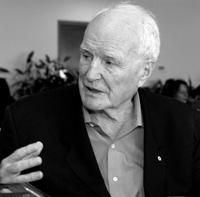
That’s what Fraser Mustard, an internationally renowned expert on early childhood development, told the ATA News when he stopped by Barnett House January 31. A companion of the Order of Canada, laureate of the Canadian Medical Hall of Fame and coauthor of the Early Years Study (1999) and Early Years Study 2 (2007), Mustard was in Alberta January 29–31 to deliver the keynote address at three forums organized by Public Interest Alberta to highlight the importance and interconnectedness of early childhood, K–12 and postsecondary education.
 While nature, or genetics, partially drives brain architecture, nurture is also a significant driver, Mustard says. The brain has 80 billion neurons, all of which have the same genetic coding. The signals they receive switch on the gene machinery, and the neurons communicate with each other through biological pathways. At the top of the hierarchy are the pathways created during the early years of life, which determine learning, behaviour and health.
"The early pathways are very hard to change if you screw them up in the early years. The later pathways are more plastic," he says.
Mustard offers the example of touch. "Children who have poor touch in the early years of life will grow up with significant behavioural problems because touch . . . affects the pathway that controls how you get up every morning and how you react every day in terms of what you do," he says. He points out that rat pups who are not intensely licked by their mothers during the first six days of life grow up with more behavioural problems and poorer memory and health than rat pups who are intensely licked.
Given the importance of the early years, Mustard maintains that teachers cannot possibly hope to reduce dropout rates unless and until early childhood development is improved. "If you have good architecture networks, you’ll continue to learn. Those who do not will stay way behind. The gap will widen," he says. While the one in four children who enter the K–12 education system with behavioural problems can be helped with drugs and support, there is no easy way for teachers to solve the problems created in the early years.
What teachers can do is advocate for the establishment of universally available early childhood development and parenting centres. In contrast to Canada, which has what Mustard describes as a chaotic patchwork of early childhood development, Sweden, South Australia and Cuba have established early childhood development and parenting centres emphasizing problem-based learning. Mustard notes that it is not cheap to establish such centres, which, if done properly, involves renovating elementary schools to accommodate them, upgrading the skills of childcare staff and paying them the equivalent of a teacher’s salary. He adds that childcare staff should complete four years of postsecondary education, with 25 per cent of the curriculum focused on developmental neuroscience.
Parents must also be involved in the centres, Mustard says. He suggests that the federal government extend maternity and parental benefits under the employment insurance program from 12 months to 18 months and that employers give parents one paid day a week to spend at the centres with their children until they start kindergarten.
With 54 Parent Link centres across the province providing parent education, early childhood development and care, family support, and information and referrals, Alberta may be partway there. Mustard estimates it would cost the federal and provincial governments, which currently spend $4 billion to $5 billion a year on early childhood development, $18 billion to establish early childhood development and parenting centres countrywide. In contrast, crime and violence, the logical result of poor early childhood development, cost the individual and society more than $100 billion a year, and mental health and addictions problems cost them an additional $100 billion. "If you’re concerned about the quality of your society for the future, $18 billion is peanuts," he says.
Mustard also urges the Alberta government to administer the Early Development Instrument, an indicator of developmental health at school entry. In Western Australia, the government established high-quality early childhood development programs in neighbourhoods where children had performed poorly on the Early Development Instrument, thereby reducing the vulnerability rate from 46 per cent to 12 per cent. "No data. No problem. No action," Mustard concludes.
Also In the News