Page Content
Richard Russell
Twenty-four hours is the flying time from Edmonton, Alberta, to Lilongwe, Malawi—the “Warm Heart of Africa.” Although separated by huge differences in geography and standard of living, connections between Canada and Malawi are strong. The Natural Resources College, the site of our project outside the capital city of Lilongwe, was built with Canadian foreign aid. The new education minister of Malawi spent five years doing post-graduate studies in New Brunswick. A strong bond has been forged by cooperation between CTF and the Teachers’ Union of Malawi (TUM).
I considered it a privilege to be chosen as a member of the Canadian team. The purpose of the Malawi project for our team of five teachers was a workshop to assist 500 Malawi primary school teachers prepare for exams. Success in these exams would help them obtain credit toward, or achievement of, the Malawi School Certificate of Education. Gaining a certificate would give teachers greater opportunities to meet entrance requirements for college.
The Canadian team helped with the teaching of specific content and helped strengthen the bond between CTF and TUM. Each Canadian teacher worked with an experienced Malawian teacher who served as a co-tutor for presentation of content in specific subject areas. My assignment was to teach 20th century world history. Our teaching days lasted from 7:30 a.m. to 4:30 p.m. and involved teaching 10 different classes over a three-week period.
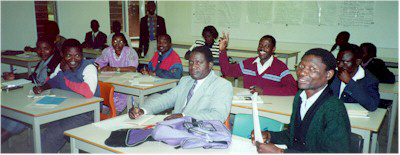
A class of Malawian primary school teachers
Malawi is a long and narrow country situated in the southern part of the East African Rift Valley, and lies between 9 and 17 degrees south of the equator. It covers over 11,800 square km, of which one-fifth encompasses Lake Malawi. The country is landlocked, surrounded by Mozambique, Zambia and Tanzania. Malawi’s population is approximately 10 million people. Around 87 percent of the population lives in rural areas. Current issues facing Malawians are health (malaria and AIDS) environmental (deforestation, water pollution, sewage and industrial waste and destruction of spawning grounds for fish) and economic (poverty).
Our team shared much information about Canada and in turn learned a great deal about life and living conditions in Malawi. Our relationship with the teachers was strengthened by interactions on both a professional and a social level. A highlight of the social interaction was a cultural evening jointly organized and presented by Canadian and Malawian teachers.
Teachers in Malawi face tremendous challenges. It was an enlightening experience to visit a primary school (Standards 1 to 8) that had a student population of 1,800 with 24 teachers. Standard 1 (Grade 1) classes had as many as 130 students in a classroom with a cement floor, no electricity and an old blackboard. The headmaster of the school we visited had an excellent organizational structure for the operation of his school, which included debate and wildlife clubs. Despite few facilities and resources, the teachers’ ways of being creative with the few materials at hand won our admiration and respect.
It was a special occasion for our team to be invited to the school and home of my Malawian co-tutor, the headmaster of a secondary school in the town of Dedza, located two hours away from our project location. Our visit took place on a Saturday while Form 4 students (Grade 12) spent extra time studying for their own Malawi School Certificate of Education exams.
On weekends we toured the country and experienced the beauty of Malawi, from the great expanse of Lake Malawi to the intriguing wildlife areas of Kasungu National Park.
Project Overseas involves sharing between one of the richest countries in the world and one of the poorest. Teachers in all the provinces and territories who contribute financially through their organizations should take pride in Project Overseas. It was with great pleasure that we learned that the agreement to continue the Project in Malawi has been extended for at least the next three years. Supporting the Teachers’ Union of Malawi in its efforts to improve education in Malawi is a key element in any program to improve the standard of living. The project also reinforces the concept that we are truly part of a global community.