Page Content
Bailey Cameron
This article was first published in the ATA Magazine (Winter 2009).
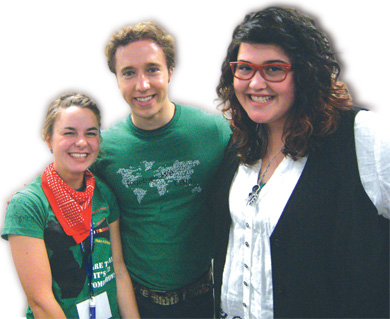
In May 2009, Northern Lights School Division hosted a student leadership conference called Care Today It’s Our Tomorrow. Keynote speaker Craig Keilburger, founder of Free the Children, is pictured with student volunteers from the conference.
During high school, I was constantly reminded of my future. I was repeatedly told that with every step and every move I was shaping my future—whether I liked it or not.
I was told that the choices I made throughout high school would affect my future on a personal, local and global level. Having thoughts about the future continuously drilled into me began to make me ask: What do I really want for my future? Do I have a bigger role to play than I at first thought?
Like most students, I had dreams of becoming a rock star or a professional athlete, but then I was given the opportunity by my high school counsellor to head up a project for our school’s social justice group. I had volunteered for other school events, but this was the first time I was to chair a major event.
The project was a fair trade marketplace where we turned our school’s student area into a coffeehouse that sold fair trade coffees and gourmet desserts, and had a market featuring products from fair trade companies. This leadership role changed my outlook on life and my future. Months of planning this event opened my eyes to the new reality of poverty, child labour, AIDS and HIV, and other injustices and tragedies taking place around the globe. Suddenly, becoming another high school rock star wasn’t important; what I needed to do was help fix the world in any way I could.
I had always known that poverty and violence are a reality, and African nations, in particular, are in distress because of HIV and AIDS. I knew that something should be done, but I never knew what, nor did I give it much thought. But then the coffeehouse became my focus. I knew that my school’s social justice group could play an important role in helping to fix the world. As we promoted fair trade and social justice, anthropologist Margaret Mead’s quote came to mind: "Never doubt that a small group of thoughtful, committed citizens can change the world. Indeed, it is the only thing that ever has."
A passion for social justice
My passion for social justice grew as I experienced the enthusiasm and excitement generated at conferences that I attended. I was inspired by other people’s opinions and witnessed their fervent desire to improve the world. What were they willing to do to make a positive difference and bring about change?
My school’s social justice group was inspired to lend its efforts to another important cause, raising awareness of the genocide in the Darfur region of Sudan. Along with a neighbouring school, we organized a 25-kilometre walk and rally featuring guest speakers and performers. The effect that this project had on me was incredible. Imagine walking along the highway as people honked their horns in support. Imagine knowing that a seed had been planted in people’s minds about why we were marching in solidarity to raise awareness of suffering in Africa. Imagine knowing that when people picked up their local newspaper or watched the evening news they remembered band of marching high school students—caring people sending a message about making changes in the world.
While we were busy opening our community’s eyes to international issues, we kept in mind that our community also includes our high school peers and that it is important to increase their awareness of the issues that affect them personally, locally and globally. We tried to start a revolution in our school. As a group committed to making a difference, we worked on emphasizing a more positive, happy, healthy and compassionate environment. We felt strongly that a school shouldn’t be a place that kids dreaded attending every day. By building fun events into our school calendar, we raised morale and awareness of social justice issues. This was an important piece of the learning for our group—the power of positive thinking. I learned much about how students react to positivity and happiness; some take it well, others do not. I felt that regardless of whether or not our peers took anything away from our school’s activities, they were at least exposed to the power of positive thinking and positive energy.
Sometimes high school students are stereotyped as unimaginative and apathetic. I beg to differ. I have witnessed students bringing about positive change, and I’ve been a part of creative and inspiring actions. For every apathetic student, every student who thinks that a 25-kilometre walk to raise awareness is a waste of time, and for every student who scoffs at the idea of bringing change to the world, I know others who have inspired me to make a difference. Joining others has taught me about the value of laughter and friendship, love, family and working as a community for the good of the community.
Participating in social justice has changed the way I look at the world. I learned that I can make a difference. I learned that people around me saw that change is possible and that change benefits many people. This revelation has helped me make kindness, compassion and empathy the guiding principles of my life every day. Change is occurring in our world, and everyone can experience it if they tune in. It is a tidal wave of caring about poverty, violence, economic issues and the environment, and about each other. And kindness is a good place to start. Smile at the grocery store clerk, leave a good tip for the waitress and offer to stay after school to help a friend study. Even simple actions can brighten a person’s day and encourage him or her to do the same. Mother Teresa said, "Every time you smile at someone, it is an action of love, a gift to that person, a beautiful thing."
I hope that during my time in high school, my fellow students and I opened the community’s eyes to international issues. The world is growing smaller, and we are increasingly affected by environmental disaster, genocide or poverty, but we can bring about change. It may take many small acts, but small acts done with great kindness have an immense influence. Change takes many forms: thinking, action or habit.
Students grow up, people change, the future is now and dreams and passions unfold. Having found my passion in the field of social justice, I hope to become a registered nurse and use my training and experiences to spread awareness of social justice. This is not a gloomy and thankless endeavour, but an optimistic, hope-filled and uplifting opportunity to spread positive thinking and a can-do spirit. Working overseas and learning about diverse cultures and developing nations help us find out more about how the world works. One of the main lessons is that as much as I might want to try, one person cannot save the world, but many dedicated and caring people can make a difference. I cannot save the world in one day or in one week, but just watch what can be accomplished in a lifetime. The same goes for every devoted student who remains committed to making a difference.
Archbishop Desmond Tutu said: "At a tender age I discovered that it isn’t doing spectacular things that make you remarkable, but instead, it is when you light just one candle to dispel a little bit of darkness that you are doing something tremendous. And if, as a global people, we put all the little bits of good together, we will overwhelm the world."
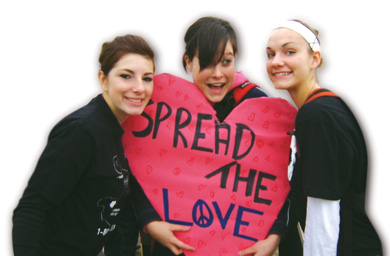
Students prepare for the walk to raise awareness about the genocide in Darfur. In October 2008 students walked 25 kilometers from Ardmore to Bonnyville, Alberta.
Tutu, D. 2004. Me to We: Finding Meaning in a Material World. Ed C. Kielburger and M. Kielburger. Mississauga, Ontario: John Wiley and Sons.Bailey Cameron graduated from Bonnyville Centralized High School in June 2009.
Also in the Learning Team
Student graduates from high school at age 64
The most important thing
Parent Tip
Understanding the natural world
We are committed to educating all children
Parents as advocates
Be the change!