Page Content
University School Grade 5/6 team teachers—left to right: Laura Lea Smart, Patti Acorn and Joe Barnett
Already reality at Calgary’s University School
The educated Albertan in 2030 will be an engaged thinker and ethical citizen with an entrepreneurial spirit.
That’s the vision laid out in the Inspiring Education report released earlier this month by Education Minister Dave Hancock. But this vision is already reality at University School in Calgary.
In April, the school held a gala showcasing approximately 20 innovative products researched and developed by its engaged, ethical and entrepreneurial Grade 5 and 6 students. The products, which were designed to solve problems faced by victims of the Haitian earthquake, included a vest that could be filled with water to provide both protection from the elements and a portable water source, Croc-type sandals with steel-enforced soles to protect feet from broken glass and other debris, and a garbage-fuelled cooking device.
The imaginative range of products was amazing. However, if you talk with University School teacher Joe Barnett you’ll discover that even more amazing were the students and the journey they took to get to the point of the gala.
It all started when Susan Crichton, an associate professor in the Faculty of Education at the University of Calgary (U of C), approached University School about a classroom-based research project that would be funded by Imperial Oil as part of a program to inspire and educate students in science, technology, engineering and math (STEM). The STEM project was to be a collaborative effort involving academic staff and students from the U of C and Grades 5 and 6 teachers and students from University School.
While Imperial Oil and the U of C each had objectives they wanted to achieve through the STEM project, so did Barnett and his two colleagues, Patti Acorn and Laura Lea Smart. These three team teachers concentrated on how to make the project valuable to their students.
“The challenge for us was how to best integrate this opportunity into the fabric of our work because we had so many curricular things we needed to get through,” said Barnett. “Taking on the project, the challenge was to make sure it was meaningful.”
In terms of the curricular aspects, Barnett, Acorn and Smart incorporated outcomes from the areas of math, science, CTS, social studies, language, health and art as opportunities presented themselves. Initially, the STEM project was to focus on electricity. That is, until an earthquake devastated Haiti on January 10, 2010. The news of the tragedy spontaneously summoned the ethical citizen in each of the students, who wanted to use the project to help the people of Haiti. “The students were instantly passionate about Haiti,” said Barnett. “It was as though there was an injustice they felt they had to put right. So, that became the path we went down.”
Engineering Intelligence
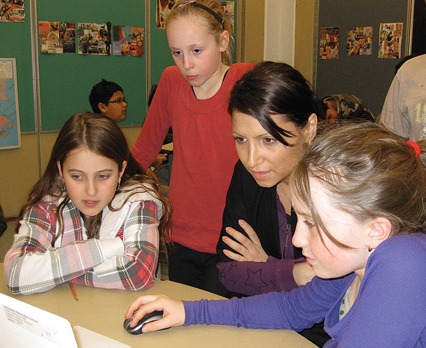
University of Calgary engineering student Ivana Dragomirova (centre) mentors University School students (left to right) Shay, Ciara and Leah during the STEM project.
With Haiti as a focus, the STEM project went into full gear. Over the next three months, University School became an intermittent home to Crichton, Dave Irvine-Halliday, U of C’s Schulich School of Engineering, doctoral students Lynn Moorman and Brown Onguko, and around 20 first- and second-year engineering students. Collaborating with Barnett, Acorn and Smart, they set out to engage, inform and further inspire the students.
The students first learned about the four basic human needs: food, water, shelter and clothing. Moorman and Onguko discussed geography and how living in a climate like Haiti’s differs from living in Canada. Moorman, using tools like Google Earth, provided information on longitudes and latitudes, and the location of Haiti. The students, full of newfound knowledge, divided into groups and selected one of the four basic needs to focus on. Then they embarked on a process to develop their product prototypes.
Each group was assigned an engineering student as a mentor, who paid weekly visits to the school, acted as consultants to their student groups and facilitated discussions that helped the students generate, select and determine the feasibility of ideas for products to help the people of Haiti. Once groups decided on their products, mentors gave them advice, knowledge and direction to produce the prototypes. To the delight of Barnett, the students gained more than information from their mentors—they gained passion.
“Our kids loved their mentors ... they looked up to them, idolized them,” exclaimed Barnett. “They saw the engineering mentors’ passion for what they were learning and they completely bought into it. They saw the mentors with their sketch books, and their own work just amped up even further. Our kids became even more passionate because of their mentors.”
The mentors were among the more than 200 guests and dignitaries who attended the school’s April gala where the students displayed the prototypes into which they had poured so much effort and passion. Guests, who had received design protocols in their event programs, visited the students’ displays and asked questions about the sustainability and affordability of the prototype designs. It was the perfect way to mark the completion of the STEM project, but for Barnett, it was a little more than that.
“It was one of the proudest moments of my teaching career,” stated Barnett. “These kids were experts, and they knew every answer to every question. They were confident and they were completely autonomous in their explanations.”
Not only were the students confident about the work they had done for the STEM project, they were confident about their futures. “They knew something had to be done for the people in Haiti, but as far as them thinking they could actually play a role in that, it didn’t seem possible for them,” said Barnett. “So what this did was say to them that, ‘Yeah, you can play a role and there are people all over the world that you can help.’ It opened up a whole new world of possibilities.”
The STEM project involved the inspiration and initiative of a major corporation, a university and an elementary school. It met curricular outcomes in seven subjects and enlightened students about a career path about which they were previously unaware. It was a journey of sharing and learning that took place over the course of three months that culminated successfully with a gala event at University School.
Ultimately, the STEM project and the collaborative efforts of everyone involved in it contributed to 80 Grades 5 and 6 students exemplifying the traits attributed the educated Alberta of 2030—20 years ahead of schedule.