Page Content
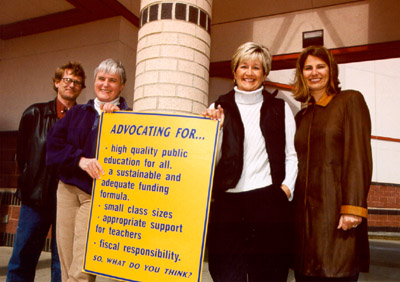
(Left to right) Parent advocates George Diduck, Catherine Ripley, Cheryl Miller and Marlene Haymour are calling for a provincial education commission composed of respected, independent and informed citizens from diverse backgrounds.—Photo by Koni Macdonald After years of hard work lobbying on behalf of public education, parent advocates across the province are calling for a serious review of education in Alberta.
Keith Fowler, a parent advocate in Lethbridge, reports that more than 200 people attended a forum in Lethbridge on April 19 to discuss the future of education. "As a representative of the government, Mr. Clint Dunford was put on the hot seat," recalls Fowler. "Most of the questions had to do with the way Bill 12 affected the morale and spirit of our education staff."
According to Fowler, one of the main points of the evening was the government's upcoming education review. "If they don't have an impartial person chairing this review panel, it will not be well received, and if an acceptable person does chair this, then the results have to be acted upon. Dunford also acknowledged that the government is going to have to act on this prior to teachers' contracts in Lethbridge being up for renewal in August of 2003."
Since 1999, Edmonton's Whitemud Coalition of Schools (representing 16 public and separate schools in the riding of Edmonton-Whitemud) has presented five position papers to Edmonton-Whitemud MLA Dave Hancock. The papers have discussed school volunteers, class size and the current needs of the schools in Hancock's riding.
The coalition's latest paper on class size states that 22 percent of Grade 1–3 classes in the riding have 25 or more students. In Grades 4 to 6, the percentage rises to 69 and in Grades 7–9 it maxes out at 94 percent. Sixty-one percent of classes in Grades 10–12 have 25 or more students.
Over the past month, members of the coalition have met twice with Hancock. Whitemud education advocate Catherine Ripley is optimistic about the coalition's meetings with their MLA. "The last meeting was to discuss possible terms of reference for, and composition of, the commission on education," said Ripley. "Ideally, the commission will allow all of us as a society to take a serious look at classroom conditions and make recommendations that the government will then act upon. I really hope that this is not just all talk."
Carol Bazinet, president of the Calgary Association of Parents and School Councils, says parents are skeptical that the commission can accomplish what it plans to do in the short time allocated. She believes the idea for a commission came from the Futures Summit. The original plan was to look at how education is delivered in Alberta and to see if the system can be improved.
"The original concept would take a long term study involving feedback from many citizens," Bazinet explains. "But the commission got tied into Bill 12 and the ordering of teachers back to work. Now it's going to deal with class sizes, fundraising and other issues that parents have been trying to bring to the attention of the government for years. It will also address issues which up until now have been issues between individual boards and local teachers' unions. These are issues which need immediate attention. Eighteen months for a report and then a further year or two before anything is implemented is just too long."
Janice Bell, a participant in both
APPEAL (Albertans Promoting Public Education and Learning) and Edmonton Advocates, believes that the commission should focus on children, public education and the future, not on partisan politics. She is encouraging parents across the province to be as active as possible in influencing the make up of the commission and ensuring that it will be valid.
"I believe that the upcoming education commission must have at its helm a strong, non-partisan, widely respected member of the community if it is to have any credibility at all," says Bell. "My personal decision as to whether or not to participate in any way will be largely based on the membership of the commission. It must have broad representation from concerned, informed parents and ordinary citizens from across this province and cannot simply be a hand-picked group who will come up with the answers the government wants. To do anything less will mean parent education advocates from across this province have simply been wasting their time for the last several years."