Page Content
Tom McConaghy
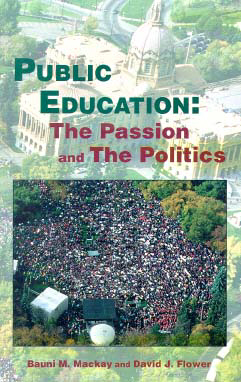 Public Education: The Passion and the Politics
Bauni M. Mackay and David J. Flower
May 1999, 168 pages
$10
Shortly after Ralph Klein's Progressive Conservatives won power in 1993, I wrote in Phi Delta Kappan that Alberta education was under siege. Among other things, I said that Premier Klein and then minister of education Jim Dinning believed that all services, no matter how essential, must be sacrificed to the deficit, deficit reduction being the deity to which the business community and right wing politicians pay obeisance these days. I also pointed out that many educators inside and outside Alberta believe that these deep cuts in education will gut the public school system and lead to the growth of private schools. The result would be a two-tiered education system that would be elitist and inequitable.
It was therefore most satisfying for me to read the factual account of the struggle for education involving the teachers of Alberta and their professional organization in Public Education: The Passion and the Politics by Bauni Mackay and David Flower. The authors succinctly recount the unfolding battle for education in Alberta from 1993 to the present. This book is history in the making. The main theme that the authors passionately pursue is, "[that] Alberta, along with the rest of the country, is rapidly moving to a fragmented two-tiered education system that will dramatically alter society."
It is obvious that Flower possesses a historian's mind as well as an understanding of the political process when recounting the events of the past six years which have shaken the foundations of an excellent education system. And it is also obvious that Mackay, who played an important leadership role as ATA president during that time, has a great passion for the welfare of all children, regardless of race, culture, economic or social status. The authors make a great team in presenting the facts and interpreting them for, not only teachers, but for all Albertans.
The authors place the events that occurred in Alberta in a global context, "thereby shedding light on what may have motivated the decisions that led to the present situation." They trace the beginning of educational reform in the United States to the launching of Sputnik by the Russians in 1957. They also show how education reform was captured by right-wing politicians and the business community in most Western democracies. They point out the determination of the political leaders in
these countries—U.S. President Bush and Britain's Margaret Thatcher—to reform education according to their ideologies. This gave Klein the courage to follow their example. After his election in 1993, Klein lost no time planning to balance the budget and restructure education, health and social services. As Mackay and Flower observe: "Buoyed by the support of right-of-centre Albertans and by the business community in particular, Klein led his team of deficit-eliminating, debt-cutting marauders forward at a blinding speed that defied interference or interruption."
It is evident that Klein believes that an important trait of a good leader is consistency. His type of consistency is to build up surpluses to reduce the debt, reduce taxes and throw a few crumbs from time to time from these huge surpluses to education, health and social services. American philosopher Ralph Waldo Emerson did not consider consistency one of the attributes of a wise statesman. In his essay "Self-Reliance," he writes: "A foolish consistency is the hobgoblin of little minds, adored by little statesmen." Mackay and Flower believe that, if education is not adequately funded, the future of Alberta and its citizens will be in jeopardy. The authors document the importance of Alberta's educational system, how it has served Alberta well and how it "makes a greater contribution to economic and social growth of the province than any other single investment."
When the ATA questioned the government about what was happening to education and the speed at which the reforms were being implemented, teachers were castigated as whiners and as a special interest group only interested in their own welfare. In order "to give the illusion that stakeholders were being consulted," the government set up a series of roundtables. The discussion at these roundtables proved fruitless since the government did not implement the many ideas from these discussions. The ATA decided to set up its own roundtables for its members to discuss their vision of Alberta education.
Since the ATA was convinced that the onward rush of restructuring education would continue unabated, it poured thousands of dollars into a public awareness campaign entitled "Know More." As well, the ATA supported several public opinion polls and invited speakers from other countries where similar restructuring of education was occurring.
Act I of this drama played out on the public stage of Alberta from 1993 to 1997. It was a victory for the government in its campaign to eliminate the deficit at any cost. Act II began when the Klein government received an even larger majority in the 1997 election. "In contrast to Act I, which was characterized by speed and chaos, Act II began with a sense of lethargy and apparent boredom." It was obvious that the government did not have a vision for spending the large surpluses that were accumulating. To find a vision, it set up a Growth Summit and invited delegates from key sectors of the Alberta economy to develop new investment strategies. The top priority from the Summit was "people development," which was ignored by the government. Following the Summit, the ATA staged a huge rally at the legislature where over 15,000 teachers and concerned parents gathered. Klein again tried to win over the teachers with his charm and the pitch: "Listen to me teachers—put down your placards and work with us."
Mackay and Flower conclude their account of the events played out in the so-called "Klein Revolution" by observing that, "Despite all the initial hype of the reforms, the education system in Alberta is now no better than it was in 1993 and indeed it may well be worse."
Teachers must not allow these crucial years to be forgotten. I urge all teachers to read this well-written and illuminating account of one of education's darkest periods. I also recommend to professors of education that they make this book required reading for all student teachers in the province's faculties of education. It is the future teachers who will carry on the battle for a better education for all the province's children who are Alberta's future. As Mackay and Flower so eloquently put it: "The right of every child to a high quality education is non-negotiable and is, in itself, the single most important factor in the creation and maintenance of a vibrant society."
Ultimately, the most important question they ask is, "If the public education system has been and continues to be the `Alberta Advantage,' why is it under siege?" The survival of Alberta's public education has concerned the Alberta Teachers' Association during the past six years and Mackay and Flower have done an excellent job in recounting the ATA's efforts in its fight to preserve it.
Public Education: The Passion and the Politics by Bauni M. Mackay and David J. Flower is available by mail for $10 (please add $2 for postage and handling) from Bauni Mackay, 13503 - 110A Avenue NW, Edmonton, AB T5M 2M8. E-mail: bmackay@compusmart.ab.ca; fax: (780) 455-5491.