Page Content
The Teaching Profession Act – A watershed moment for teachers
It is fairly said that the pursuit of professional status for teachers was a core value of the Alberta Teachers’ Alliance from its inception in 1918. The ATA’s founders worked tirelessly between 1918 and 1936 to convince first the Liberal, then the United Farmers of Alberta (UFA), and finally the Social Credit governments to enact legislation establishing teaching as a profession with all the concomitant privileges and responsibilities attending that status.
To tell the story of the Teaching Profession Act, however, means honouring the relentless work of the ATA’s first members to convince the powers that be of teachers’ vital role in the development of the province and their readiness to safeguard the public trust in law. The Alberta Teachers’ Alliance of 1918 was a voluntary organization. Teachers were encouraged to join and to maintain their membership year to year. Collective action was promoted as key to the advancement of teachers and their economic and professional status. A call to action appeared on the cover of Volume 1, Number 1 of the ATA Magazine (June 1920) and its language reflects the spirit of the day.
Fellow Teachers
Are you a member of the ATA? If not, do you know that you are a clog on the efforts of three-quarters of your fellow-workers in this Province?
Are you indifferent about the $1,200 minimum?
If you are, you are betraying the hand that supports you, and no amount of empty drivel about “the missionary spirit,” or pious humbug about “patriotism,” can disguise the fact.
Do you meet persons who express doubts about the propriety of teachers’ organizations, and who advise you to keep clear of anything so banal or “common” as a “union”?
Mark those persons. They are your enemies. They fear organization, much preferring that you should remain what you are, an individual powerless to resist domination.
Magistri neque servi
Work at the ATA continued, first in Barnett’s private home, and later in rented premises at the Imperial Bank Building on Edmonton’s Jasper Avenue. Teachers sought and received help, support and advice. School boards found themselves facing determined teacher advocates. Nevertheless, a great deal of effort continued to be spent on organization-building: renewing teachers’ annual memberships, establishing locals, adopting policy and generally keeping the lights on. John Barnett, the first permanent general secretary-treasurer, personally undertook canvassing and the building-up of the membership even if it was accomplished one teacher at a time. Biographer and colleague A.J.H. Powell recounts the scope of Barnett’s Herculean efforts:
John Barnett’s constituency consisted of 5,000 teachers scattered from Fort Smith in the north to Whiskey Gap in the south; from Jasper in the west to Lloydminster in the east; and he had to get out and sell to them the idea of professional solidarity—an idea priced at five dollars [per annum]—in competition with vendors of Watkins products, Rawleigh liniments, doctor books and Wearever aluminum. Either sell the idea or go back to his classroom.1[1]
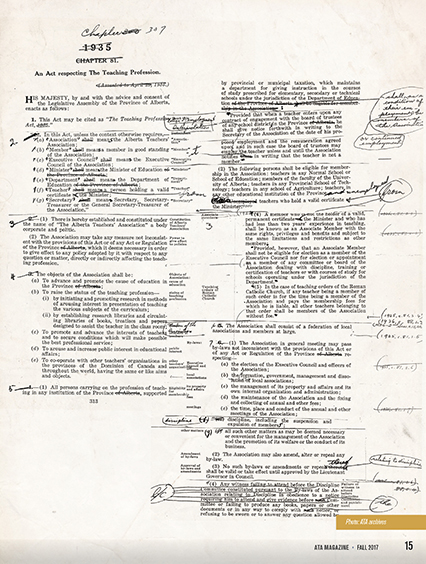
Photo: ATA archives
Despite the perpetual need to travel and sign up new members, Barnett and first ATA president George D. Misener saw the need to establish teachers’ professionalism and to set the standards by which the ATA would operate. Among their first priorities was to advance a “Code of Honour” in 1918 establishing Alberta’s first standard of teacher professional practice. That early document, though brief, was stamped with hallmarks of a drive towards collegiality and professionalism.
It shall be considered an Unprofessional Act:
(1) To disregard the validity of a formal contract with a School Board.
(2) To criticize adversely, except in an official capacity, the efficiency of a fellow-member of the Alliance.
(3) To pass along rumors derogatory to a fellow-member of the Alliance, whether such be based on fact or not.
(4) To seek professional advancement by other than professional means.
(5) To seek employment with a School Board:
(a) Not in good standing with the Alliance.
(b) Already having a member of the Alliance under contract for the same position.
(6) To make known to non-members, except through authorized channels, the proceedings of a Committee or General Meeting of the Alliance (1918–1919).
Resolutions at the second annual general meeting a year later (1919) directed the fledging ATA to assert the professional voice of teachers in school planning and administration as well as conditions of practice.
Resolution (6). That the ATA recommend that all Local Alliances request their School Board to admit an advisory committee of teachers to all School Board Meetings.
And so the business of the ATA continued for another twelve years. In 1932, as the Great Depression began to tighten its grip on Albertans, the Alliance continued its struggle to collect membership dues and to keep up advocacy for teachers in increasingly desperate economic circumstances. Their efforts were rewarded.
In 1934, ATA members were surveyed about whether to support a bill before the Alberta legislature brought forward by UFA minister of education Perren Baker. Alliance members of 1934 might fairly have been surprised to have their sanction sought for introduction of legislation to establish their professional status. After all, Perren Baker and John Barnett had locked horns over many teachers’ issues over the entirety of Baker’s tenure and, lo, here arrived Bill 91 of 1935: An Act Respecting the Teaching Profession.
The reality, of course, was that the Alliance leadership, including Barnett, had long since been engaged in lengthy negotiations for such a legislative instrument. The UFA government under Premier Richard Gavin Reid had agreed that legislation establishing a teachers’ organization was timely. The proposed bill would require mandatory ATA membership for all as a condition of employment and empower the ATA to conduct professional discipline. The catch? Teachers’ approval was required. A plebiscite ballot was distributed to ATA members in the October 1934 issue of the ATA Magazine. Results were published in the January 1935 issue: 2,770 in favour, 54 against. The ATA presented Baker and Reid with a 98.4 per cent mandate to proceed with the bill.
What followed was a firestorm of opposition emerging primarily from the UFA’s main constituency. The Reid government’s out-front support for the bill waned. In the end, An Act Respecting the Teaching Profession went forward as a private member’s bill and not as a government-sponsored one. The Alberta School Trustees Association mounted strong opposition to Bill 91 and the ATA responded by mounting an equally potent campaign in support of the legislation. The battle ended with Bill 91 passing by two votes (25–23) but the bill was a hollowed-out shell of its original self. In response to the outcry against the act, the government had eliminated mandatory membership and the ATA’s right to discipline teachers — two important pillars of all professional organizations.
Barnett, never a man to mince words, mightily resented the opposition to mandatory membership particularly from members of the legislative assembly who were themselves members of other professional organizations, but who had nevertheless objected to teachers claiming that status. In the very next issue of the ATA Magazine (May 1935), Barnett expressed his “burning sense of injustice”[2] in an editorial titled “I am Holier than Thou” (p.1).
As it happened, the newly renamed Alberta Teachers’ Association did not endure this disappointment very long. In August, 1935 the UFA government was defeated so profoundly that their majority evaporated in the heat of late summer. Not a single sitting UFA member was returned to the legislature. A new premier, William Aberhart, a teacher and high school principal, assumed the mantle of leadership and formed a Social Credit government.
Within months, in April 1936, the Aberhart government passed an amendment to the Teaching Profession Act and made membership in the Alberta Teachers’ Association mandatory as a condition of employment in publicly funded schools. With the stroke of a pen, Aberhart also empowered the Association to discipline members, strengthened the all-important Board of Reference and required school boards to advance dues to the Association on behalf of their employed teachers.
Freed from the necessity of perennial membership drives, the Association turned its full attention to fulfilling its new statutory obligations and to building a strong, determined, effective and respected teaching profession. The Teaching Profession Act was a watershed moment for teachers in Alberta, one that forms the core of the Alberta Teachers’ Association today.
Maggie Shane is the archives manager for the Alberta Teachers’ Association.
[1] Powell, A.J.H. 1962. Unpublished memoir.
[2] Chalmers, J. 1968. Teachers of the Foothills Province. Toronto: University of Toronto Press, p. 127.