Page Content
Susan Nobes
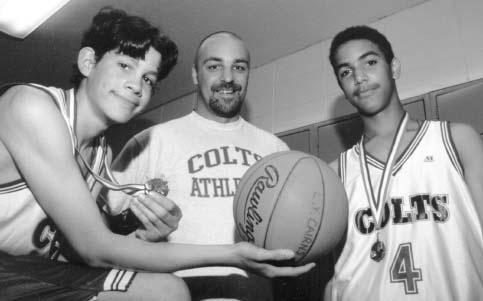
It is the final moments of what has been a well played, sportsmanlike game of junior high boys' basketball—the Tier 3 city finals in fact, for Edmonton. The buzzer sounds the end of the second half and a ball drifts, as if in slow motion, toward a net. But this isn't Hollywood and the game won't be won by a last desperate shot tossed with hope in these precious, fleeting seconds. The players line up to shake hands after the game and to prepare for the medal presentation. School principals have the honor of congratulating the team members and coaches. Silver and gold medals are draped over teenage heads damp from the fast-paced competition. Over the public address system, a game official acknowledges the excellent manner in which the athletes conducted themselves during the final contest. It is a proud moment for all concerned, and especially significant for the L.Y. Cairns Colts team members, and indeed, their entire school community.
All schools are proud of their teams. But this team is special. Edmonton's L.Y. Cairns offers programs to adolescents with moderate to severe intellectual, physical, emotional and mental health challenges. And it took an outstanding coach and novice teacher to see that the students attending L.Y. Cairns should participate as fully in district athletics as do teens attending junior and senior high schools. By doing so, teacher Shawn Irwin has set a precedent for other schools to include players with disabilities in their interschool athletics programs—and not only as equipment managers.
When Irwin began tryouts for the interschool sports squad, it had been so long since the school had put forward a team that even 20-year veterans on the teaching staff were unable to remember the team moniker. So the team was christened the "Colts" and a new page in yearbook history was created by, and for, some remarkable people. Undaunted by sports organizations previously unaccustomed to including L.Y. Cairns on game schedules, Irwin politely persisted and the Colts were entered into the interschool league. No uniforms? Not a problem. A silent auction fundraiser initiated by this determined educator was well supported by donations from local businesses. The auction drew many staff members and parents eager to support the cause. All who attended were inspired by Irwin's hope that what had previously been a closed arena for special needs students would now be open to athletes with disabilities.
For Irwin, the issue of playing or not playing a sport is simple. "All students should have the opportunity to participate in athletics regardless of their physical, intellectual or behavioral challenges. Athletics is an excellent way to raise self-esteem, especially if kids don't excel academically. Behaviorally troubled students can often benefit immensely from the structure, discipline and camaraderie of team sports."
It hasn't been smooth sailing for Irwin and the athletes. He has had to adjust techniques and expectations to match the abilities of the team. Memory plays a big factor in basketball strategies, and this can be a problem for some students. The discipline of frequent and focused practice helps. Another challenge is transportation. Some team members do not yet have the skills or parental permission to use public transit and travel to and from school by yellow school buses. As a result, Irwin has spent many hours driving players home after games. However, the benefits outweigh the barriers. School attendance for some students was a problem before they joined the athletics program. Now, Irwin reports a major reduction in absenteeism that he attributes to membership on the sports team. Improved attitude toward school and a resultant improvement in achievement are other positive spin-offs Irwin credits to structured athletic involvement.
And talk about courage! These kids never say die when it comes to a game. Irwin shares a story about the time the team was down 40 points with three minutes left to play, and the boys asked, "Do we still have a chance?" Irwin smiles, shakes his head in wonder and comments, "They go out to play their hardest no matter what."
What is it that drives Irwin to take his career responsibilities that extra, ever so significant, distance to involve special needs kids in sports? His answer is simple yet poignant. "I want to have us treated equally amongst our peers. It hasn't happened completely yet. I want our kids to get respect and lose the stigma of `dummy school.'"
It is heartening to note that both boys and girls from L.Y. Cairns are now participating in district track and field events, and other students have made it onto Victoria High School's football and basketball teams. Would this have happened without the commitment of Shawn Irwin and the indomitable courage of kids who struggle in a school system and yes, in a society that tends to undervalue these students' achievements and contributions? As a profession, we must embrace the way this third-year teacher "walks his talk" and makes us think in innovative ways about the education and potential of youth with disabilities. Let's all contribute to making special yearbook memories possible for more kids.
Susan Nobes teaches at L.Y. Cairns School in Edmonton. This article first appeared in the Fall 1998 issue of The ATA Magazine.
Photo by Koni Macdonald