Page Content
Laura Harris
Reprinted from the ATA News, volume 42, number 6
It hasn’t qualified as a fad just yet, but stationary exercise bikes, barbells and Pilates balls for children ages four and up have hit the market. Concerns over childhood obesity and diabetes might strengthen this movement toward pint-sized fitness equipment, but if the Canadian Association for Health, Physical Education, Recreation and Dance (CAHPERD) achieves its vision, such fads will never be a match for a good physical education program.
CAHPERD believes daily physical education in schools is essential to the healthy development of children and youth. During the 2006/07 school year, it bestowed 1,063 schools across Canada with a Quality Daily Physical Education (QDPE) Recognition Award for excellence in physical education. One of the 218 Alberta schools receiving the honour was Neil M. Ross Catholic School, an elementary school in St. Albert.
Neil M. Ross Catholic School received the Diamond Level QDPE award, CAHPERD’s highest standard for physical education programming. Criteria for the award included providing 30 minutes of phys ed programming every school day, having qualified phys ed teachers on staff, promoting inclusion and incorporating a wide range of activities into phys ed and intramural programming.
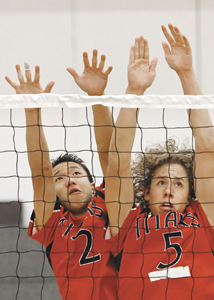
Sleight Anstruther, the school’s vice-principal, listed a number of activities in which Neil M. Ross students are involved. Basketball, volleyball, dance, and track and field made the list, before he proudly mentioned the activity that’s been a mainstay at the school. “We have a running club that’s been going on for the better part of 10 or 11 years.” Anstruther elaborated that the running club’s improvised running track is a 100-metre, two-lane hallway linking 12 portables. Jammed with speeding students from 7:30–8:15 a.m., the stretch of hallway rivals a freeway at rush hour. “You’re taking your life in your hands if you try to walk down that hallway in the morning,” laughed Anstruther.
Inclusion is a high priority for staff at Neil M. Ross School. “We get everybody—and I mean everybody—to participate," said Anstruther. “We’ve got a number of students with special needs varying from autism to Down’s syndrome that are incorporated into the regular classroom as much as possible … especially phys ed.” The enthusiasm for inclusion also extends to staff.
“Our staff is good at getting out and participating with the students at lunch hours,” said Anstruther, citing examples of student–teacher hockey games, or administrators or teachers kicking a soccer ball around with the students at recess. In the eyes of Anstruther, a benefit of participating in physical activities with students is that it helps build relationships, not just stamina. “It allows you that opportunity to bond with kids on a different level, there’s that connection … it allows us to be seen as human. You’re not that person who has to have all the right answers,” he said, adding that establishing bonds with students makes it easier to relate to them if a disciplinary situation should arise.
Physical education programs like the one offered at Neil M. Ross are worthy of the QDPE diamond designation because they provide students with excellent health benefits. Just as important, they help students acquire important life skills that come with social interaction, being part of a team and trying new things—skills one wouldn’t get riding an exercise bike or lifting a barbell.
−Photo by Greg Ranieri