Page Content
Shelley Svidal
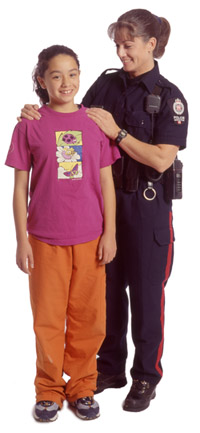
The position of school resource officer, presently held by experienced police officers, could be open to individuals without specialized law enforcement training if a government committee has its way.
Chaired by Calgary-Hays MLA Art Johnston, a former sergeant with the Calgary Police Service, the Special Constable Program Review released its recommendations in December following eight months of stakeholder consultation. The committee recommends school resource officers be designated as Level 1 community peace officers, the third tier of a four-tiered public security peace officer program.
Unlike current school resource officers, who have undergone a rigorous classroom and field training program, the new school resource officers would require only a high school diploma, with recommended qualifications including training in cardiopulmonary resuscitation and first aid and successful completion of the provincial physical abilities test. While allowed to carry batons and pepper spray, school resource officers would no longer be allowed to carry firearms. School boards, not police agencies, would be their employer.
Right now, the cost of school resource officers is shared by police agencies and school boards in most parts of the province although the officers are employed by their respective agencies. Making school boards the employer could allow police agencies to reassign school resource officer positions to the street.
Indeed, cost-cutting seems to be one of the rationales for the recommendation. "Alberta is a province like no other. Our booming economy is attracting more and more people everyday. An enviable position, indeed, but the downside of this prosperity is increased pressure on our law enforcement services. To respond to these rapidly increasing demands, we must develop a seamless system that improves the manner in which we serve and protect Albertans," the committee writes.
Professional Development staff officer Barb Maheu, who serves as the Alberta Teachers’ Association’s representative on the Society for Safe and Caring Schools and Communities Advisory Council, sees the recommendation as an attempt to deprofessionalize an important public service. "It’s very critical that school resource officers have law enforcement backgrounds for all kinds of good reasons," she says.
Maheu points out that "schools are microcosms of society and the kind of violence that can occur on the street is the same kind of violence that can occur in school. Having a person on hand who knows how to handle a potentially violent situation and knows the law about handling violent situations is critical."
The extensive training program that police officers go through gives them a certain maturity and dedication that a recent high school graduate would be unlikely to have, Maheu says. In addition, officers who become school resource officers tend to display a deep understanding of issues related to adolescents. "Police agencies are very aware of the need to select officers who can relate to the specific needs of students," she says.
The Alberta Association of School Resource Officers would agree. "While police officers are highly trained individuals, the position of a school resource officer is unique and requires police officers to approach situations from a new perspective," it states on its website.
Maheu adds that school resource officers are not simply law enforcers. They are also educators, working with teachers and helping them implement curricula like the drug abuse resistance education program. "They do a lot of prevention, and that requires a mature, professional person who can work effectively with teachers and school administrators," she says.
She questions whether community peace officers would have the authority to earn students’ respect and serve as positive role models. "It’s important for students to see police as positive role models in nonconfrontational settings. The presence of a police officer in school does a lot to portray a positive image of the police with students and bread down media-driven stereotypes."
The committee’s recommendation does not necessarily mean that police officers would vanish from schools altogether. They would still have a role, even if it were limited to responding to 911 calls from community peace offices confronted with situations they are not equipped to handle. Neither would the recommendation deny police agencies or school boards the opportunity to continue to assign trained police officers to schools.
Solicitor General and Public Security Minister Harvey Cenaiko, who, like Johnston, is a veteran of the Calgary Police Service, describes the recommendations as a way to enhance the important work of peace officers, heretofore known as special constables. "Consultations will continue to further refine the recommendations, which will be used to develop new legislation to govern the program," he says.
Also In the News