Page Content
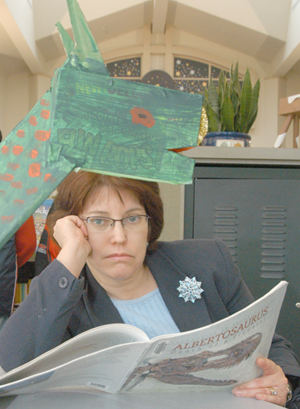
Fern Reirson, teacher–librarian at Jackson Heights School in Edmonton, has little reason to smile when it comes to the state of Alberta’s school libraries.—Photo by Koni Macdonald
Fern Reirson
"You’re a rare bird. I didn’t know any of you still existed."
This comment was directed toward me last year as I led a class on a field trip to gather information. Now, I’ve begun introducing myself as "one of Alberta’s endangered species—a teacher–librarian." In fact, if I were a bird in Alberta, I would meet the criteria for the status of endangered: "a species facing imminent extirpation or extinction."
A Statistics Canada report (2005) indicates that the average school in Alberta has 0.07 percent teacher–librarians. As a profession, teacher–librarianship is almost extinct. The cries of teacher–librarians have simply been obliterated by reallocation or reprioritization, coinciding with cuts to education funding and school-based budgeting. With few teacher–librarians left, it is only a handful of committed citizens who are working to ensure not only my survival as a species but also an entire ecosystem, the school library media program.
Since becoming a professionally trained teacher–librarian during the 1990s, I count myself blessed to still hold the position of teacher–librarian in an elementary school in Alberta. I am one of 12 full-time equivalent (FTE) learning resources staff who has kept her job (unlike most of my 81 FTE colleagues from 1990) in one of Alberta’s largest school districts. Today, there is little to ensure my survival. As the statistics acknowledge, I really am "a rare bird" in Alberta schools.
Why care about extinction?
If we don’t know what a species is and its role in the ecosystem, how can we value it? Long gone are the days when tired or stressed teachers were delegated to the library as a last pit stop on the road to retirement. Today, my role is part teacher, part librarian, part techno-wizard, a school leader and change agent.
As our title indicates, we are teachers first. Ninety per cent of my time is spent in direct teaching, in small groups, designated classroom instruction or team teaching, modelling for or mentoring other teachers in the areas of inquiry and technology-based learning.
Second, as a librarian, I develop the school’s collection of resources. Areas of the collection are identified for development based on curricular needs and changes, student/teacher interest and use, and the mandate of Canadian content. Flexible scheduling allows students access to the library all hours of the day, increasing the circulation of reading materials and opportunities for instruction in library/computer-based skills. I work as part of a team with a principal, teachers, a library technician, and student and community volunteers to maximize the use of our school library media program.
I am the technology lead teacher on staff. I model and train staff to integrate technology with curriculum and guide students through the use of new technologies. I am continually working to develop my own skills in new technologies, such as video conferencing. I maintain the school website used by students from our own and other learning communities. Teacher–librarians today demonstrate expertise in the uses of multiple technologies and literacies.
As a leader and change agent, I am a member of my school’s instructional leadership team, guiding our school community in instructional focus work. Opportunities abound to provide professional development for teachers inside and outside my school; introducing new social studies curriculum and inquiry-based learning and using computer software. I am involved in action research through video conferencing among other schools and University of Alberta preservice teachers. Teacher–librarians lead and learn by example.
Teacher–librarians are noted as a vital component of school libraries in research literature. More than 40 years of international research indicates that professionally staffed school libraries (teacher–librarians supported by library technicians) with a wide variety of reading materials improve student achievement (Haycock 2003). Even adjusting for factors of socio-economic status and different levels of schooling, there is abundant evidence that qualified teacher–librarians influence school libraries. Despite such evidence, we continue to vanish from schools and school libraries.
How healthy is your school library media program?
Roch Carrier, national librarian of Canada, likens school library media programs to "the heart of the school." A teacher–librarian is like the practitioner who keeps his or her finger on the pulse of this learning ecosystem. Without a teacher–librarian, who knows how healthy the heart of your school culture really is? Today, the disparity of Alberta’s school libraries varies not only from district to district but also from neighbouring school to neighbouring school. Depending on the commitment by school councils, administrators and district leaders, school libraries can be exemplary or destitute. In some cases, the entire ecosystem, the library itself, is shut down or in such a state of disrepair it becomes irrelevant and obsolete. An English teacher begged me to back up her rescue of her school’s library books that were in storage. She was berated by her school administrator and parents for involving her students in setting up a mini-library in her English class. She just wanted to give her students something to read! Without teacher–librarians, it is often courageous teachers like this who are left to battle on their own. I was able to give her the Achieving Information Literacy: Standards for School Library Programs in Canada as a guide to support her case.
What is spent on resources?
Little is spent on library collections—both print and electronic. The collection analysis done by my graduate students in the teacher–librarianship by distance learning program indicates that the average age of a school library’s book collection is between 15 and 20 years. When the state of the school library collection is finally reassessed, schools have to find $40,000 to rebuild their collections. Approximately $4,000 is spent annually on books in Alberta schools (Statistics Canada 2005). Alberta has one of the higher provincial averages. National standards for school library programs in Canada advocate budget spending of $35 to $45 annually per student. In a school of 300, that equates to at least $12,000 a year. The average school in Alberta isn’t spending one-third of that amount to maintain its library collection. Print resource costs have gone up 60 per cent in the past 15 years. According to Statistics Canada (2005), the average expenditure on audiovisual resources barely covers the cost of renewing new video/DVD and/or video-streaming licensing in one year. The amount expended on electronics would not purchase one LCD projector bulb or laser printer cartridge. There is a lack of understanding about the real cost of resources.
Who is selecting resources and what is selected?
In the fifth largest school district in Alberta, only one elementary school out of 26 has a teacher–librarian choosing books. The others have library assistants selecting books. Most of these library assistants have no training whatsoever. Also, the only books bought in the last 10 years in most of these schools are free books earned from Scholastic Book Fairs. This doesn’t do much to ensure that our students develop a love of diverse, rich literature or develop a sense of identity by reading Canadian literature.
Teacher–librarians are key to the survival of schools’ libraries
Without trained teacher–librarians, access to the library collection remains limited. Research or inquiry-based learning is difficult, as teachers struggle with the lack of time, skills and up-to-date resources. A library technician recently contacted me for advice on how to teach the school staff about the Focus on Inquiry document (Alberta Education 2004). Though I applauded her initiative in seeing the need to teach children using an inquiry model, I questioned why this job was being done by non-certificated staff. I am told by learning resources consultants from across Alberta that it is common for non-certificated staff to teach information skills. As stakeholders in the school’s ecosystem, we must not ignore or resign ourselves to these changes that are slowing the heartbeat of our school library media programs.
What can we do?
Even if we have an understanding of the state of an endangered species and its environment, do we have the will to bring about change to ensure its survival? Teaching for the University of Alberta’s teacher–librarianship by distance learning program has given me a clearer understanding that school libraries are truly in crisis throughout Canada. The Statistics Canada (2005) report provides evidence of it. I often equate the ecosystem of the school library with that of a car. If you don’t maintain your vehicle, add fuel to it or use it with care, you won’t have it for long. It may sit in your garage but not function. Why do we think libraries are any different? If we don’t train people to use them, maintain them and add to their collections, we will soon have a pile of dust collectors. Just as we do not let untrained young people drive on our roads, so we need to have trained professionals—teacher–librarians—guiding our students through the glut of information they encounter daily.
Bringing about change
We can bring about change in the health of our school libraries in the following three ways:
Acknowledge—We need to recognize that school libraries are in crisis in Alberta. Alberta Education needs to designate someone to examine the health of our school libraries. At the school and district levels, we need to collect data about our school libraries.
Assess—We need to assess the state of school libraries in Alberta at the provincial, district and local school level. Achieving Information Literacy: Standards for School Library Programs in Canada can be used to evaluate the health of our school libraries. Priorities need to be identified at all three levels (provincial, district and local) based on the analysis of school libraries.
Act—We need to increase funding for library staff and maintenance to meet the Canadian standards for school libraries. Professional development of teacher–librarians and library technicians would be encouraged and promoted through the University of Alberta’s teacher–librarianship by distance learning program and Grant MacEwan College’s information management and library technology program.
Ask your MLA, school board trustee and school administrator about the health of school libraries, and ask that action be taken. The alternative is going, going … gone …
Fern Reirson is the teacher–librarian of Jackson Heights School in Edmonton and president of the Greater Edmonton Regional Learning Resources Council of the Alberta Teachers’ Association. She has been a sessional instructor for the University of Alberta’s teacher–librarianship by distance learning program and is on the board of the Canadian Coalition for School Libraries in Canada.
References
Alberta Learning. 2004. Focus on Inquiry: A Teacher’s Guide to Implementing Inquiry-Based Learning. Edmonton: Alta.: Learning Resources Centre.
Asselin, M., J. Branch and D. Oberg. 2003. Achieving Information Literacy: Standards for School Library Programs in Canada. Ottawa, Ont.: Canadian School Library Association.
Statistics Canada. 2005. School Libraries and Teacher–Librarians. www.statcan.ca/Daily/English/050504/d050504a.htm (accessed January 10, 2006).
Haycock, K. 2003. The Crisis in Canada’s School Libraries: The Case for Reform and Re-Investment. Toronto, Ont.: Association for Canadian Publishers. Also available at www.peopleforeducation.com/librarycoalition/Report03.pdf
(accessed January 10, 2006).
Also In the News